Updated 12 September to include the very first ship
Being of European stock all of the branches that make up my family tree came to Australia at one point or another by ship. I can trace my first Australian ancestors to six ships over the years. Why are ships the transport mode of choice? Well, the first three of the voyages occurred before airplanes were invented, the next two occurred after airplanes were invented, but before commercial flights were available between Australia and Europe. While the fifth voyage occurred in 1949 when my dad’s family traveled here as displaced persons of the Second World War with limited means, so they didn’t have much choice in the matter.
The following is a short summary of all six ships in chronological order along with a bit of the stories that go along with them.
Heejeebhoy Rustimjee Patel “The Patel”
1846 – My fourth great grandmother on my mum’s side, Charlotte Henriette Blankenburg (Grabsdorff) traveled to Australia on the Heejeebhoy Rustimjee Patel with her second husband Heinrich Adolf Polack (listed as a miner from Silesia) with her daughter from her first, tragically short marriage, Maria Auguste Agnes Therese (my third great grandmother) and their two children, Auguste Henrietta Amelia and although unnamed on the ships list, would have been Johanne Luise, on it’s second and last journey to South Australia, embarking from Bremen, Germany on 27 June 1846, and arriving in Port Adelaide on 28 October 1846.
The Patel was a three masted ship, about 510 tons, and built in Alexandria Virginia in 1842 as the Virginia. She was sold to Erich F Oelrichs of Bremen and, intended for the eastern trade routes, was renamed the Heerjeebhoy Rustomjee Patel after a well-known Indian merchant. Proving unsuited to that task she was used for the South Australian run. The Patel made two voyages to South Australia under the command of Captain Eugen Laun.1
Unfortunately I have been unable to find a picture of the ship, but once I do, I will include it here.

Lady McDonald

1854-1855 – James and Jane Ford (my 4x great grandparents on my mum’s side) arrived in South Australia with their children on the Lady McDonald clipper ship. On the passenger list it states that James was a farmer from Crowcombe, England. Nels Agustoff Lawsen (my 3x great grandfather who later changed to Lawson) also traveled on the Lady McDonald working as a seaman. During the voyage to Australia Nels and the Ford family became so friendly with each other that my Great Uncle Ted noted Nels was invited by James Ford to join them in South Australia.
The only reason I am aware Nels was on the same ship is due to my great uncle’s notes. Unfortunately most lists of employees on ships have not survived the years and so any information regarding Nels, who was a Swedish man born in Sweden, and his travels prior to this voyage are lost.

Toward the end of the passenger list is a list of all passengers who were nominated by purchases of land in South Australia and towards whose passages, or outfit, money has been paid into the Colonial Treasury, who have received Embarkation orders to join the ship.5 The Ford family are also on this list.
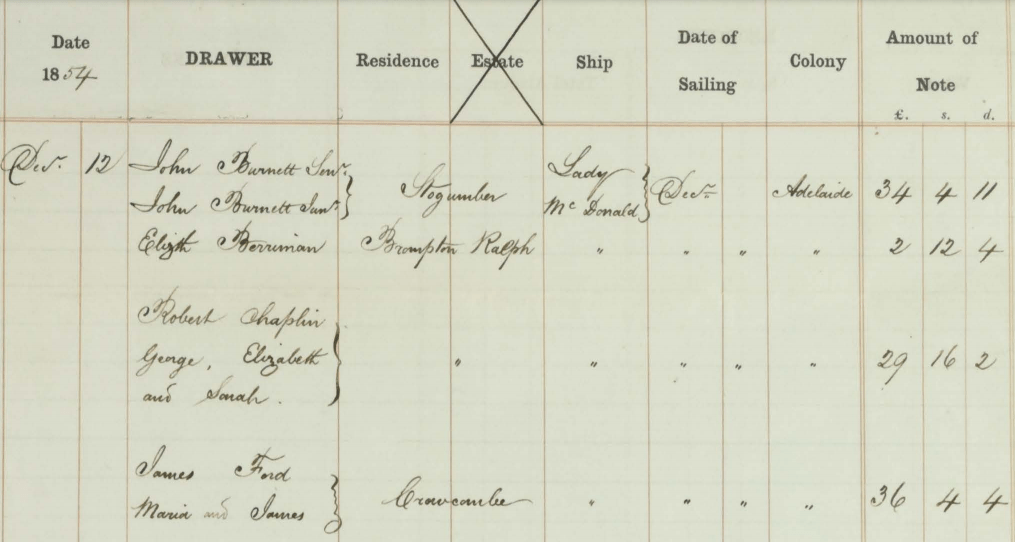
James Ford and his family received land in Stockport, South Australia. As an employee of the ship, Nels would not have been offered a plot of land and so James would have put him to work on the Ford farm.
Although I have no idea why they packed up and left the United Kingdom, two events that could have contributed to their decision include the fact that in 1854 the UK declared war on Russia, effectively joining the Crimean War, and most likely throwing into chaos the economic potential and daily lives of its citizens; and secondly, also occurring that same year, there had been an epidemic of cholera in London, killing 10,000 people. A third event on a much more personal note is that James Ford’s father passed away the previous year, in May 1883. His mother had passed many years prior when he was six years old, and it appears that Jane’s parents had also passed by this time. As the last parent had now passed, and with war and disease rising around them, I am guessing that the thought of moving to Australia may have been an attractive one.
The Lady Macdonald departed Plymouth, UK on 15 December 1854, a short ten days before what would have been a unique Christmas filled with hope and expectation.
The ship was still quite young, having been built seven years earlier in 1847 by a Mr Dunbar of London, and the voyage took four months, docking at Port Adelaide, South Australia on 7 April 1855.
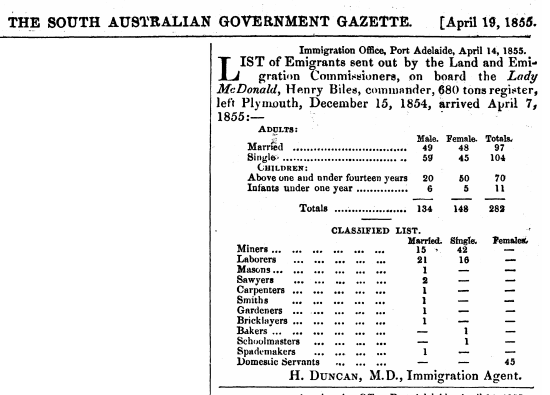
The South Australian Government Gazette 1855 provides a good snapshot of the types of passengers on the ship.
Further general information with regards to this voyage can be found on The Ships List via the address listed below8.
Hesperus
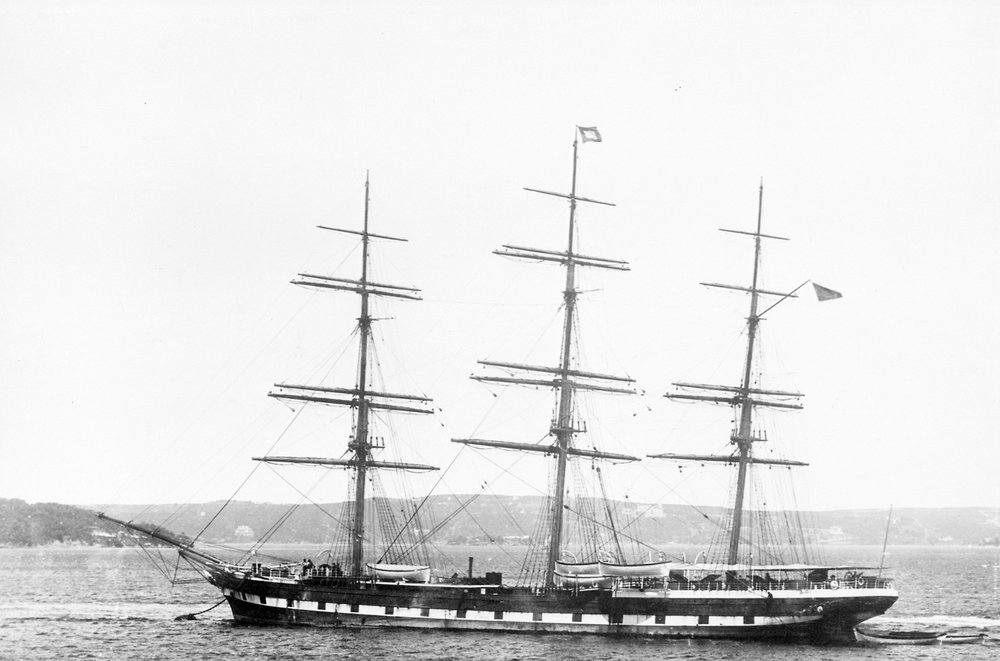
1883 – Charles and Susanah Paynter (my 2x great grandparents on my mum’s side) arrived in South Australia with their eight children on the Hesperus clipper ship.
The Hesperus departed London on 3 July, 1883, arriving in Plymouth, UK, on 13 July where Charles, Susanah and their children boarded before it headed to Port Adelaide, where it arrived on Monday 24 September, just over ten weeks later.
Charles Paynter kept a diary of his travels to Australia, which is currently in the possession of the Mortlock Library in South Australia. This is an item that I will research further when I have an opportunity. Hopefully that diary will provide me with answers to why they came to Australia, and a whole lot more.
The following screen captures are from the State Records of South Australia, and all can be found in the one document in the bibliography at the end of this article10.


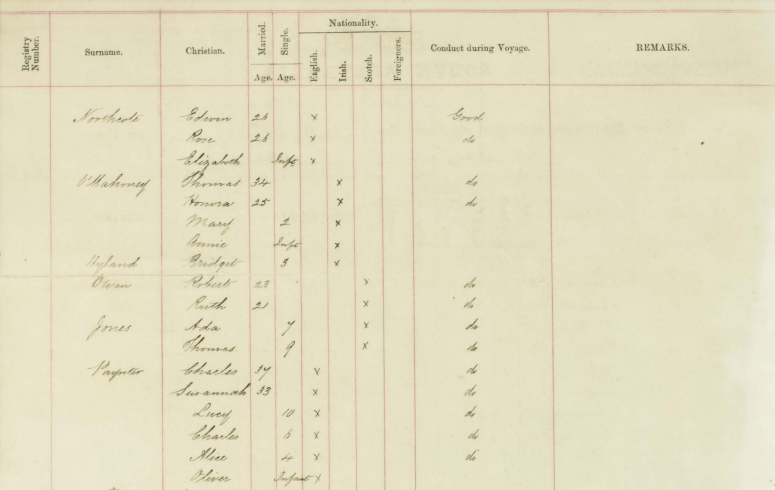
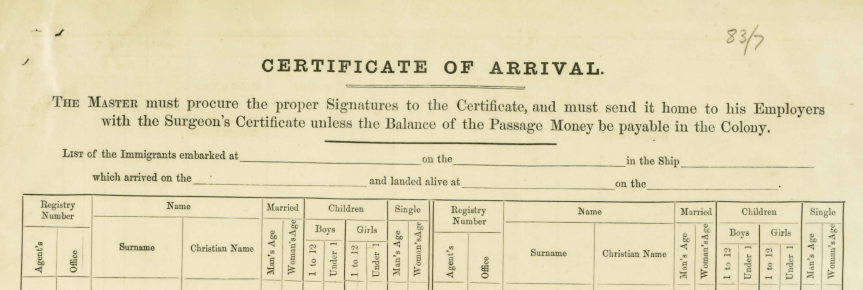


Wikipedia states that “the Hesperus was a sailing ship built by Robert Steele & Company of Glasgow in Greenock, Scotland in 1873 under the supervision of John Legoe for Thompson & Anderson’s “Orient Line” as a replacement for Yatala, which was wrecked off the coast of France, and built especially for the South Australian trade route.
She was an iron-hulled full-rigged ship of 1,777 tons register, length 262.2 feet (79.9 m), beam 39.6 feet (12.1 m), depth 23.4 feet (7.1 m).
The Hesperus changed hands a couple of times. In 1899 it changed hands for the third or forth time, to the Russian government and was renamed Grand Duchess Maria Nikolaevna, serving on the Black Sea as a sail training vessel, based in Odessa. In 1921 she returned to Great Britain, and once again as “Silvana” entered the maritime service. She did not however live up to her reputation as a “flyer”, and made disappointing times; whether due to the ageing ship, a less aggressive captain, or less responsive crew will never be known”10. According to wikipedia she ended her existence in a breaker’s yard in 1923, but the South Australian government website Passengers in History report that in 1924 she was scrapped in Genoa12.
HMS Otranto

1911 – Samuel Cunnington (my great grandfather on my mum’s side) arrived at Fremantle, Western Australia on HMS Otranto on 21 February 1911. He was listed as single and a labourer.
HMS Otranto was built in 1909 and named after the Strait of Otranto between Italy and Albania. It was built by Workman, Clark and Company at its Belfast shipyard for the Orient Steam Navigation Company’s England to Australia run. The first attempt to launch the ship failed on 23 March 1909 as the tallow used to lubricate the slipway had frozen and Otranto ground to a halt after sliding only 20 feet (6.1 metres). Attempts to persuade her to resume her progress with hydraulic jacks failed and the slipway had to be partially rebuilt before she was successfully launched four days later. She was completed on 20 July and departed London on her maiden voyage to Brisbane, Australia, on 1 October 1909.
In 1910 the company was awarded a contract to carry mail and she was redesignated as RMS Otranto, the RMS standing for Royal Mail Ship. She was present at King George V’s Coronation Naval Review on 26 June 1911 and made several voyages to the Norwegian fjords before mid-September when she returned to the Australia run, on which she remained until war was declared on Germany on 4 August 1914.
During the war she was primarily used to search for German commerce raiders. She played small roles in the Battle of Coronel in November 1914 when the German East Asia Squadron destroyed the British squadron searching for it and in the Battle of the Falklands the following month when a British squadron annihilated the Germans in turn.
Apart from brief refits in the UK, Canada and Australia, she remained on this duty until early 1918 when she became a troop ship. During a severe storm off the Isle of Islay in late 1918, she was accidentally rammed by another troop ship and forced ashore by the storm, killing 470 passengers, mainly American soldiers, and crewmen.13
RMS Orama
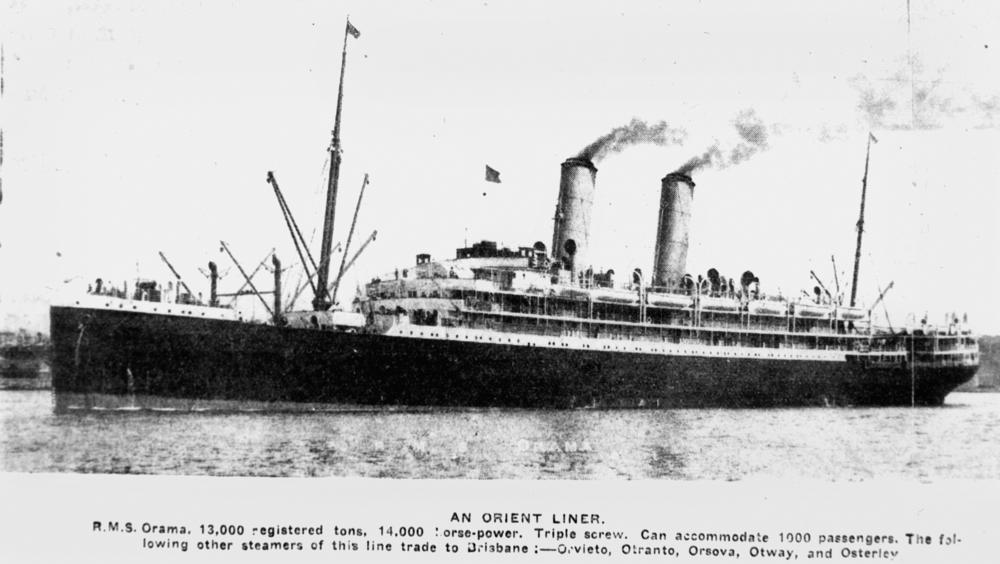
1914 – Lucy Florence Watkins (my great grandmother on my mum’s side) came to Australia, landing in Western Australia as a single 23 year old woman in 1914. Departing the Port of London as a 3rd class passenger on the RMS Orama. This one way trip would have cost £20 (approximately £2,300 today) on what was, at the time, the largest steam ocean liner sailing between Great Britain and Australia. This Royal Mail Ship (RMS) was still a very young ship, having been launched only a few years earlier in Ireland, in 1911.
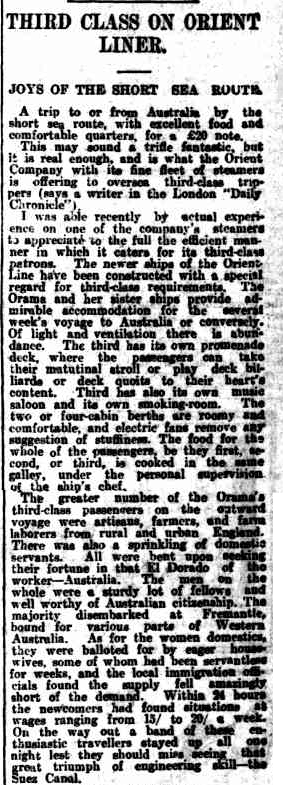
Being a third class passenger on the RMS Orama would have been quite a comfortable experience. The Adelaide Advertiser ran an article on 8 May 1914 describing the accommodations of the third class passengers. I have included the first half of the article. The rest of the article not shown below describes a fairly dramatic incident where a third class passenger took a header over the side. The article states the event was certainly not on the sports programme, but it might have been, to judge by the promptitude with which the victim of his own folly was rescued from death. According to the article contact with the water had cooled the mans heated brain15, the RMS Orama stopped, and the passengers cheered on two rescue boats as they tried to reach the man. If you want to know how it all turned out, you will need to read the full article in Trove.
Lucy departed London, UK on 22 May 1914. In April of the same year, the famous Australian Antarctic explorer, geologist and academic, Sir Douglas Mawson OBE FRS, traveled on the RMS Orama from Adelaide to Tilbury.
Later in 1914 the RMS Orama was converted into an armed merchant cruiser. In 1915 the ship took part in the brief Battle of Mas a Tierra off Chile, then in 1917 a U-boat (military submarine) sank her in the Southwest Approaches (the offshore waters to the southwest of Great Britain)16.
SS Oxfordshire
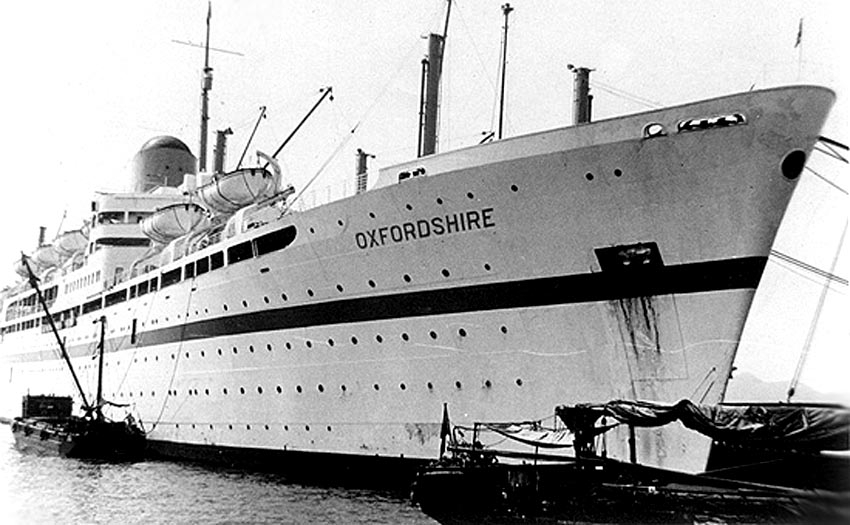
1949 – Michajlo and Stefania Potiuch (my dad’s parent’s) arrived at Port Adelaide on the SS Oxfordshire in May 1949 with their four young children, one of them being my dad who was 5 years of age. My dad spent the first five years of his life in an American camp in Germany during the Second World War, until boarding the SS Oxfordshire in Italy to make the journey to Australia as Ukrainian refugees. I expect I will write a post detailing their full trip to Australia as I have more information with regards to their time prior to coming to Australia.
Of interest is that the dad of one of my long time friends from my school days, who I am still very good friends with, was also a child on the same ship traveling with his parents as Lithuanian refugees.

The SS Oxfordshire was launched 15 June 1912, and was in service until 1958. It was 474ft 6in (144.63m) in length, and had a speed of 15.5 knots. It was converted into the first British army hospital ship and could carry 562 patients. In April 1915 the ship was sent to Mudros Harbour where it acted as a Base Hospital Ship, remaining there until the evacuation of Gallipoli. During WW1 she carried in excess of 50,000 wounded to their destinations utilising 6 Medical Officers, 13 Nurses and 41 other personnel. She was capable of caring for 22 Officer casualties, 216 in cots and 324 in berths. On 24 Mar 1919 she was returned to her owners and after being converted to oil burning propulsion she resumed commercial service.18
On 3 Sep 1939 with the outbreak of WW2 she was once again requisitioned as a Hospital Ship, serving in the Mediterranean, Africa and the Pacific including Okinawa.19
In April 1949 she made the first trip for the International Refugee Organisation, carrying the first refugees from Europe to Australia, which is the journey my dad’s parents took with their children, and my friend’s dad took as a toddler.
The ship was finally broken up at Karachi in 1958.20
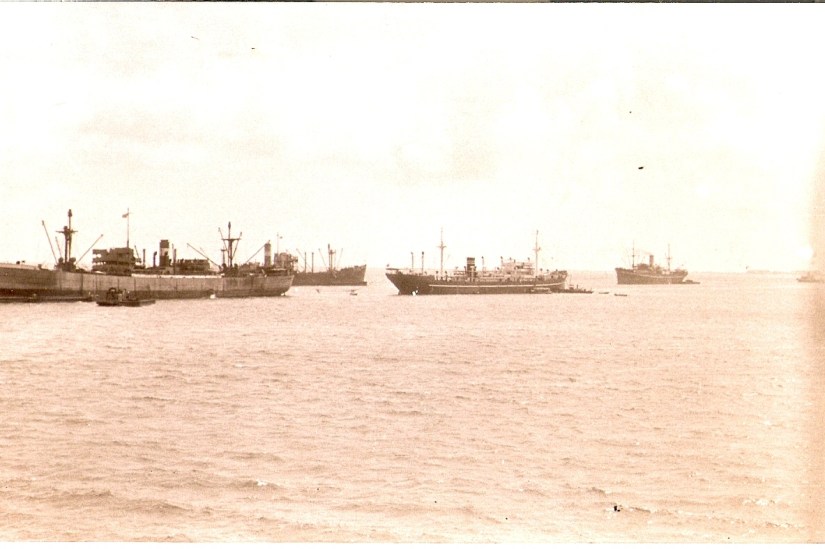
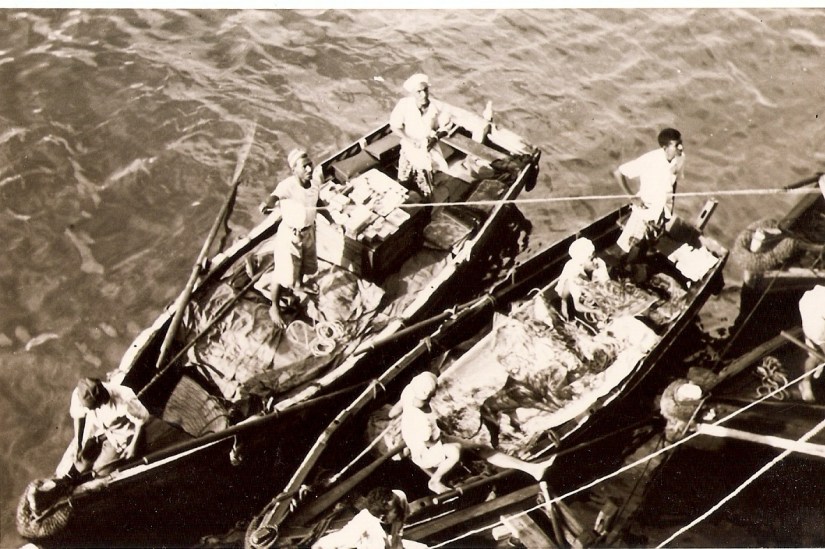
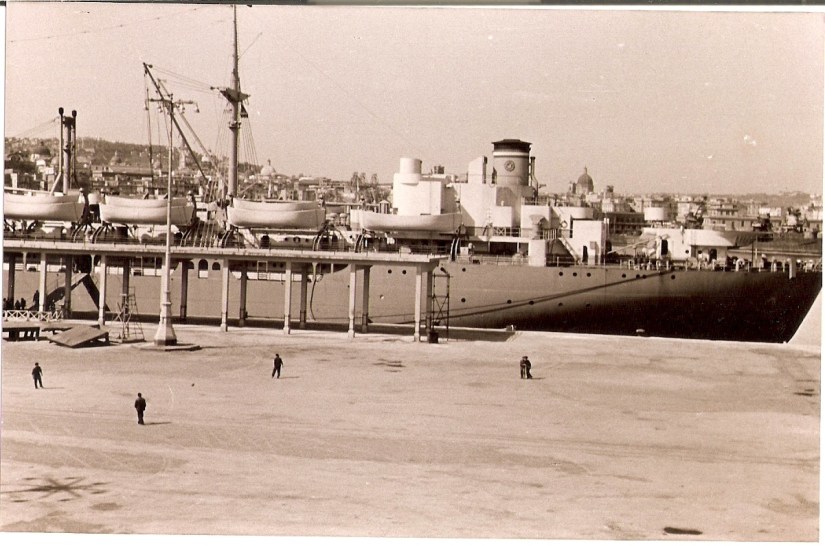
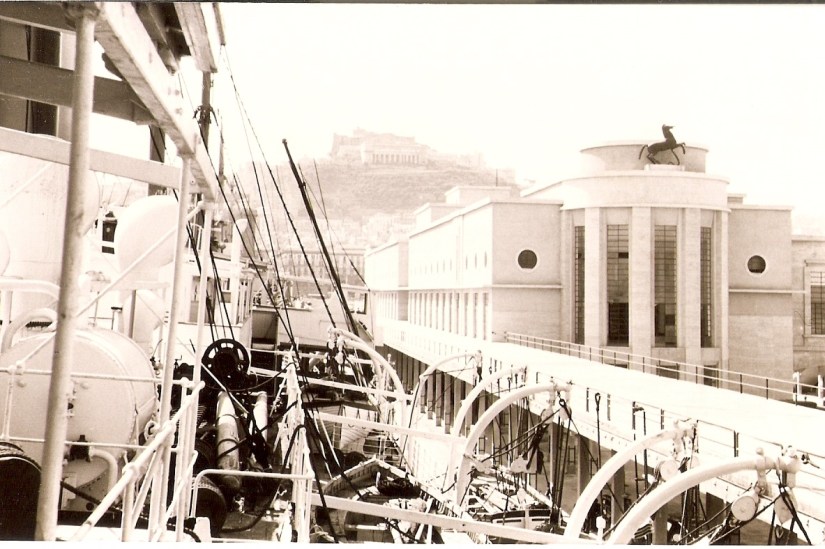
Below I have included some photos from my family’s private collection of their journey to Australia in 1949 having boarded the ship in Italy before sailing to South Australia. In the last photo from left to right is my uncle (half cut off), my auntie, an unknown ship worker, my dad, and my uncle.





Bibliography
1 https://moadstorage.blob.core.windows.net/$web/Lehmann_Henschke/Ships/patel.html
2 http://www.artuk.org/artworks/the-ship-lady-mcdonald-174824
3 https://en.wikipedia.org/wiki/1854_in_the_United_Kingdom
4 & 5 & 6 https://archives.sa.gov.au/sites/default/files/documentstore/passengerlists/1855/GRG35_48_1_55-9_Lady%20McDonald.pdf
7 http://classic.austlii.edu.au/au/other/sa_gazette/1855/16.pdf
8 http://www.theshipslist.com/ships/australia/ladymacdonald1855.shtml
9 https://commons.wikimedia.org/w/index.php?curid=57683259
10 https://archives.sa.gov.au/sites/default/files/documentstore/passengerlists/1883/GRG35_48_1_83-7_Hesperus.pdf
11 https://en.wikipedia.org/wiki/Hesperus_(clipper_ship)
12 https://passengers.history.sa.gov.au/node/927721
13 https://en.wikipedia.org/wiki/HMS_Otranto
14 https://en.wikipedia.org/wiki/RMS_Orama_(1911)
15 https://trove.nla.gov.au/newspaper/article/6411386
16 https://en.wikipedia.org/wiki/RMS_Orama_(1911)
17 http://ssmaritime.com/oxfordshire.htm
18 https://birtwistlewiki.com.au/wiki/SS_Oxfordshire
19 https://birtwistlewiki.com.au/wiki/SS_Oxfordshire
20 https://passengers.history.sa.gov.au/node/933369 19.8.22

 Potiuch Roman Cunnington Paynter Family Tree